
Retail inflation declined to over six-year low of 2.1 per cent in June, nearing the RBI's comfort zone, on account of subdued prices of food items, including vegetables, driven by widespread monsoon.

India's annual rate of inflation, based on its monthly Wholesale Price Index, climbed to 6.01 per cent for the month of May 2014, as against 5.20 per cent for May and 4.58 per cent during the corresponding month of the previous year, which has set off alarm bells.

The WPI number follows retail inflation (CPI) data, which had slipped to a record low of 3.78 per cent in July.

The wholesale price index's annual rise compared with a 7 per cent jump forecast by economists in a Reuters poll.
Use a mix of instruments that will beat both the wholesale and consumer price indices

The wholesale price-based inflation rose to an eight-month high of 1.48 per cent in October, as manufactured products turned costlier. The WPI inflation was 1.32 per cent in September and zero per cent in October last year. This is the highest level of wholesale price index-based (WPI) inflation since February when it was 2.26 per cent.

Retail inflation jumped to a 15-month high of 7.44 per cent in July as prices of vegetables and other food items spiked, according to official data released on Monday. The Consumer Price Index (CPI) based inflation was at 4.87 in June and 6.71 per cent in July 2022. Previously, high inflation was recorded at 7.79 per cent in April 2022.

A little away from the city in the northern suburbs, vegetables are 15-30 per cent costlier.

Inflation has reappeared as a global issue in both advanced and emerging economies and India needs to be wary of "imported inflation", especially due to high oil prices, according to the Economic Survey 2021-22 released on Monday. "Inflation has reappeared as a global issue in both advanced and emerging economies. "India's Consumer Price Index inflation stood at 5.6 per cent YoY in December 2021 which is within the targeted tolerance band," the survey report presented in the Parliament by Finance Minister Nirmala Sitharaman noted.
The finance ministry has proposed that services should be included in the widely tracked wholesale price-based inflation index to reflect true picture of price changes in the economy.
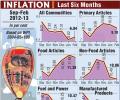
The wholesale price index, the main inflation indicator, rose an annual 6.84 per cent in February, higher than the 6.54 per cent rise estimated by analysts.

Inflation in food articles during June stood at 2.04 per cent, as against 1.13 per cent in May.
RBI might retain rates at current levels, upside risks to inflation rise.
Inflation moderates, but government can and must do more.

The wholesale price-based inflation shot up to an all-time high of 10.49 per cent in April, on rising prices of crude oil and manufactured items. Also, a low base of April last year contributed to the spike in inflation in April 2021. The WPI inflation was 7.39 per cent in March 2021, and (-) 1.57 per cent in April 2020. This is the fourth straight month of uptick seen in the wholesale price index (WPI)-based inflation.
WPI at 3-month high; surge in all broad categories; CPI at 2-month high.

Wholesale inflation shot up to a 30-month high of 5.25 per cent in January as rising global crude oil prices spiked domestic fuel cost, even as food prices moderated.
Inflation fails marginally to 4.52 per cent for the week ended July 15 from the 4.68 per cent in the previous week, despite increase in prices of vegetables, some edible oils and metals.

Potato, a daily consumable vegetable, witnessed maximum inflationary pressure at 60.58 per cent

Wholesale price-based inflation rose to a record high of 15.88 per cent in May on rising prices of food items and crude oil. The Wholesale Price Index-based inflation was 15.08 per cent in April and 13.11 per cent in May last year. "The high rate of inflation in May, 2022 is primarily due to rise in prices of mineral oils, crude petroleum & natural gas, food articles, basic metals, non-food articles, chemicals & chemical products and food products etc. as compared to the corresponding month of the previous year," the commerce and industry ministry said in a statement.

Fall in both WPI and CPI inflation to pressure RBI, say analysts
Inflation rose to 4.77 per cent for the week ended September 23 from 4.56 per cent in the previous week, mainly due to spurt in prices of pulses, wheat and iron ore.

For the consumer, there would be practically no impact on prices of essential medicines this year.

This increases expectations that RBI may cut rates later this month.

Retail inflation in March inched up to 8.31 per cent from 8.03 in February, mainly on account of a rise in fruit and vegetable prices.
Inflation crossed five per cent mark to touch 5.16 per cent for the week ended September 30 from 4.77 per cent in the previous week mainly due to increase in the prices of energy, food and manufactured items.

Food prices, which have contributed to a large part of inflation over recent years, have remained benign, despite unseasonal rain.
Inflation declined marginally to 4.91 per cent for the week ended August 19 from 4.92 per cent in the previous week despite increase in prices of minerals, food and manufactured items.
Inflation declined marginally to 4.61 per cent for the week ended July 29, from 4.67 per cent in the previous week mainly due to cheaper food items, including milk.

Since March 2020, WPI food inflation rate continued to fall but the CPI-food inflation rose, signaling a breakdown in supply chain from the mandis to the final household.

Vegetables account for 5.44 per cent of the Consumer Price Index.
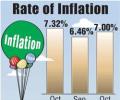
Food prices rose 18.19 per cent year-on-year in October, slower than an annual rise of 18.4 per cent in September.

The median forecast for wholesale price index-based inflation in the first quarter of 2010/11 is at 10.4 per cent, according to Reserve Bank of India's survey, higher than 9.5 per cent in the previous survey.
During the week, prices of fish marine were dearer by 10 per cent, arhar, fruit and vegetables by 2 per cent each while urad and moong rose by 1 per cent each.

Data on primary and fuel items would continue to be released on weekly basis.

The RBI's idiosyncratic focus on wholesale price inflation at the expense of retail inflation is a serious policy error.
The short-term inflation outlook for India is benign, and the expectation of a normal monsoon and moderating global prices of key imported items give credence to the projections made by the RBI and IMF, the Economic Survey said on Monday. However, to ensure long-term policy stability, the Survey 2023-24 suggested making focused efforts to increase the production of major oilseeds, expanding the area under pulses, and assess the progress in developing modern storage facilities for specific crops.

Indian households database Consumer Pyramids answers why two years of high inflation did not matter to the consumers of the country.
Inflation remained unchanged at the previous week's level of 5.16 per cent for the week ended October 7

The Commerce and Industry Ministry will soon seek Cabinet nod to give out inflation data every month instead of the present practice of weekly release.
